Hexagon Calculator
This free online hexagon calculator solves a regular hexagon from any single value you already know. Enter the side length, the circumradius (R), the apothem (r), the area or the perimeter, and it returns the other four quantities plus the height, the diagonals and all three angle measures — with the formulas shown below and a to-scale diagram you can drag. Think of it as an online hexagon solver for the six-sided case: one input in, the whole shape out.
Settings
Share Results
Generate an image with the current diagram and detailed results to share with your friends.
Visualization Preview
Regular HexagonCalculation Details
Detailed Parameters
| Side Length (a) | — |
|---|---|
| Apothem (r) | — |
| Circumradius (R) | — |
| Diagonals | — |
Angles
What Is a Regular Hexagon?
A regular hexagon is a six-sided polygon whose six sides are all equal in length and whose six interior angles are all equal, each measuring 120°, for a total of 720°. Its six vertices sit on one circumcircle and its six sides are tangent to the incircle, so the shape has both a circumradius R (center to a vertex) and an apothem r (center to the midpoint of a side, also called the inradius).
The regular hexagon has a property that makes it the easiest of all the regular polygons to work with: because 2 sin(π/6) = 1, the circum radius of hexagon shapes is exactly equal to the side length, R = a. Six equilateral triangles of side a therefore fit around the center with no leftover space, which is also why hexagons tile a plane without gaps — the geometry behind honeycombs, cell structures, nuts and bolts, floor tiles and the hexagonal grids used in games. To measure hexagon shapes you only need one of the six quantities, and every other length, angle and area follows from it.
Hexagon Formulas and Principles
Every formula hexagon geometry needs is listed below, and all of it comes from the same set of identities for a regular n-gon with n = 6. The tool evaluates them directly in terms of π/n, with no intermediate angle-based rounding step; only the final display is rounded.
| Symbol | Meaning | Relation for a regular hexagon |
|---|---|---|
| a | side length | the value you enter, or solved from R, r, A, P |
| R | circumradius (center to vertex) | R = a / (2 sin 30°) = a |
| r | apothem / inradius (center to side) | r = a / (2 tan 30°) = (√3/2)a ≈ 0.8660a |
| A | area | A = ½·n·a·r ≈ 2.5981a² |
| P | perimeter | P = n·a = 6a |
| h | height (vertex to vertex) | h = 2R = 2a |
| θi | interior angle | θi = 180° − 360°/n = 120° |
| θc | central angle | θc = 360°/n = 60° |
| D | number of diagonals | D = n(n − 3) / 2 = 9 |
Interior and central angle. The two angles add up to a straight angle of 180°, so each one fixes the other:
\[ \theta_i = 180^\circ – \frac{360^\circ}{n} = 120^\circ, \qquad \theta_c = \frac{360^\circ}{n} = 60^\circ \]
Side and circumradius. The side is a chord spanning a central angle of 2π/n, and at n = 6 that chord is exactly as long as the radius:
\[ a = 2R\sin\frac{\pi}{6} = R, \qquad R = \frac{a}{2\sin(\pi/6)} = a \]
Side and apothem. The apothem is the leg of the right triangle formed by half a side and the radius:
\[ a = 2r\tan 30^\circ \approx 1.1547r, \qquad r = \frac{a}{2\tan 30^\circ} = \frac{\sqrt{3}}{2}a \approx 0.8660a \]
Area. A regular hexagon is six congruent equilateral triangles of side a around the center, which gives the area of a hexagon formula used by the tool, plus two equivalent forms when you only know r or R:
\[ A = \frac{1}{2}nar = \frac{3\sqrt{3}}{2}a^2 \approx 2.5981a^2, \qquad A = 6r^2\tan 30^\circ = 2\sqrt{3}r^2 \approx 3.4641r^2, \qquad A = 3R^2\sin 60^\circ \approx 2.5981R^2 \]
Perimeter, height and diagonals. The perimeter is six sides; the height is the vertex-to-vertex span, which for an even number of sides is the full diameter 2R:
\[ P = na = 6a, \qquad h = 2R = 2a, \qquad D = \frac{n(n-3)}{2} = 9 \]
Working backwards. To calculate side length of hexagon problems, invert the same identities — the tool does it without iterating:
\[ a = \sqrt{\frac{4A\tan 30^\circ}{6}}, \qquad a = \frac{P}{6} \]
Diagonal lengths. The diagonal of hexagon formula for the count is D = n(n − 3) / 2 = 9, and those nine diagonals come in two kinds: three long ones through the center, each 2R = 2a, and six short ones that skip a single vertex, each √3a ≈ 1.7321a.
Input and output. Input: exactly one positive number — a, R, r, A or P. Output: the other four quantities, plus the height h, the diagonal count D and the interior, central and summed angle measures.
Precision and boundaries. Only positive numbers are accepted; an empty or zero field shows an em dash (—) instead of a number. Results are rounded to two decimals, and a whole number is displayed without a decimal point, so an area of exactly 93.53 stays 93.53 while a side of exactly 12 stays 12 rather than 12.00. Angles are given in degrees. The calculation is unitless: the length you type comes back in the same unit and the area in square units of that unit. Note that the vertex-to-vertex span (2a) and the flat-to-flat span (2r ≈ 1.7321a) are different numbers, and the tool reports the first one as the height, matching the orientation of the diagram.
How to Use the Hexagon Calculator
- Choose what you already know in the Known Value dropdown: Known Side Length (a), Known Circumradius (R), Known Apothem (r), Known Area or Known Perimeter. Only the matching input stays on screen, pre-filled with a default (20 for the side, 17 for R, 14 for r, 688 for the area, 100 for the perimeter).
- Type your number in that field, or drag the slider below it — the two are linked, so either one recalculates the hexagon immediately as you move it.
- Read the results in three places: the Calculation Details card (area, perimeter, height), the Detailed Parameters table (side length, apothem, circumradius, diagonals) and the Angles block (interior, central and sum). Those three blocks are the dimensions of a hexagon calculator output: every length and angle in the shape, derived from the single number you typed. Press Calculate if you want to force a refresh.
- Compare the numbers with the diagram: it is drawn to scale, and you can drag to rotate it, zoom in and out, or reset the view without touching your input. This is the fastest way to sanity-check the shape before you write the number down.
- Keep the result with Share Results — the share link carries your value, so reopening it restores the same hexagon — or generate a PNG image of the diagram and the full result set. Reset clears the form and returns to the defaults.
Worked Examples
Example 1 — area of a hexagon with a 6 in side
This works as an area calculator for hexagon problems where the side is known, and as an area of a hexagon calculator when you would rather read the answer than do the multiplication: start from a = 6 in, the apothem is r = a / (2 tan 30°) = 6 / 1.1547 = 5.1962 in, and the area of a hexagon formula gives A = ½·n·a·r = ½ × 6 × 6 × 5.1962 = 93.53 in², which matches the shortcut A ≈ 2.5981a² = 2.5981 × 36 = 93.53 in². Because R = a for a hexagon, the circumradius is also 6 in, the height is 2a = 12 in and the perimeter is 36 in.
| Quantity | Value |
|---|---|
| Side length (a) | 6 in |
| Circumradius (R) | 6 in |
| Apothem (r) | 5.2 in |
| Perimeter (P) | 36 in |
| Area (A) | 93.53 in² |
| Height (h) | 12 in |
| Diagonals (D) | 9 |
| Interior / central angle | 120° / 60° |
| Angle sum | 720° |
Example 2 — hexagon size calculator from a known perimeter of 60 cm
Perimeter is the easiest entry point, and it turns the page into a hexagon size calculator as well: a = P / 6 = 60 / 6 = 10 cm. The circumradius is 10 cm, the apothem is r = 10 / 1.1547 = 8.6603 → 8.66 cm, the area is A = ½ × 6 × 10 × 8.6603 = 259.81 cm², and the height is 20 cm.
| Quantity | Value |
|---|---|
| Side length (a) | 10 cm |
| Circumradius (R) | 10 cm |
| Apothem (r) | 8.66 cm |
| Perimeter (P) | 60 cm |
| Area (A) | 259.81 cm² |
| Height (h) | 20 cm |
Example 3 — start from a known area of 1,000 ft²
Going the other way, solve for the side from the area: a = √(4A tan 30° / 6) = √(4 × 1000 × 0.5774 / 6) = 19.62 ft. The apothem is 16.99 ft and the circumradius 19.62 ft, so the perimeter is 117.71 ft and the height is 39.24 ft. You can also use the tool as a hexagon side length calculator the other way round: enter the side and read the area, as in Example 1.
| Quantity | Value |
|---|---|
| Side length (a) | 19.62 ft |
| Circumradius (R) | 19.62 ft |
| Apothem (r) | 16.99 ft |
| Perimeter (P) | 117.71 ft |
| Area (A) | 1000 ft² |
| Height (h) | 39.24 ft |
Hexagon Calculator FAQ
How many sides and diagonals does a hexagon have?
Six sides and nine diagonals. A hexagon is defined by six straight sides and six vertices, and in the regular case every side and every interior angle is identical. The nine diagonals break down into three long ones through the center (2a each) and six short ones (≈ 1.7321a each), and the tool reports the total in the Detailed Parameters table.
What is the interior angle of a regular hexagon?
120°. The interior angles of a hexagon add up to 720° — the general rule is (n − 2) × 180° — and in the regular case each one is 720° ÷ 6 = 120°. The exterior angle and the central angle are both 60°, and six of them complete a full turn around the center.
How do I find the area of a hexagon?
Use A = ½ × perimeter × apothem, or the single-input form A ≈ 2.5981a² when you know the side. If you know the apothem instead, A ≈ 3.4641r²; if you know the circumradius, A ≈ 2.5981R². This area of hexagon calculator needs only one of the five quantities, and the same number also returns the perimeter and the height, so you never have to re-enter the shape to get the other measurements.
What is the area of a hexagon with a known radius?
Because the circumradius equals the side, a known radius is a known side: R = 12 in means a = 12 in, so the apothem is 10.39 in, the area is 374.12 in², the perimeter is 72 in and the height is 24 in. That shortcut only works for the regular hexagon, where R = a; for any other regular polygon the two are linked by R = a / (2 sin(π/n)) instead.
| Known value | Result |
|---|---|
| Circumradius (R) | 12 in |
| Side length (a) | 12 in |
| Apothem (r) | 10.39 in |
| Perimeter (P) | 72 in |
| Area (A) | 374.12 in² |
| Height (h) | 24 in |
Can I use this as a hexagon volume calculator for a hexagonal prism?
Not directly — this page solves the flat regular hexagon, which is the base of a prism. To get a hexagonal prism volume, take the area from here and multiply it by the prism depth: the 6 in hexagon above has a base area of 93.5307 in², so an extrusion 10 in deep has a volume of 93.5307 × 10 = 935.31 in³. If you need the surface area of the same prism, it is 2 × 93.5307 plus the perimeter times the depth, 36 × 10 = 360, for a total of 547.06 in² — the results above give you both numbers in one pass.
What is the difference between the apothem and the circumradius?
The apothem r runs from the center to the midpoint of a side (5.2 in for a 6 in hexagon), while the circumradius R runs from the center to a vertex (6 in for the same shape, since R = a). Their ratio is fixed at R / r = 2 / √3 ≈ 1.1547. Because the vertex-to-vertex span is the diameter 2R = 2a, the tool doubles as a diameter of a hexagon calculator any time you enter the side: the diameter is simply twice the default number, and the flat-to-flat width you would measure with a caliper across two parallel sides is 2r ≈ 1.7321a instead.
How do you handle an irregular hexagon?
There is no single formula, because unequal sides and angles leave too many degrees of freedom. Split the shape into triangles from one vertex, use the shoelace formula if you have the vertex coordinates, or measure it on a grid; for perimeter you just add the six side lengths. This page is not an irregular hexagon calculator: it solves the regular case exactly, and applying the regular formulas to an irregular hexagon will give you a wrong area.
Does the calculator convert between units?
No — it is unitless by design. Enter the side in centimetres, inches or feet and the length results come back in that same unit, with the area in the corresponding square unit. Just do not mix units inside one calculation: convert first, then enter one consistent set of numbers.
Related Tools
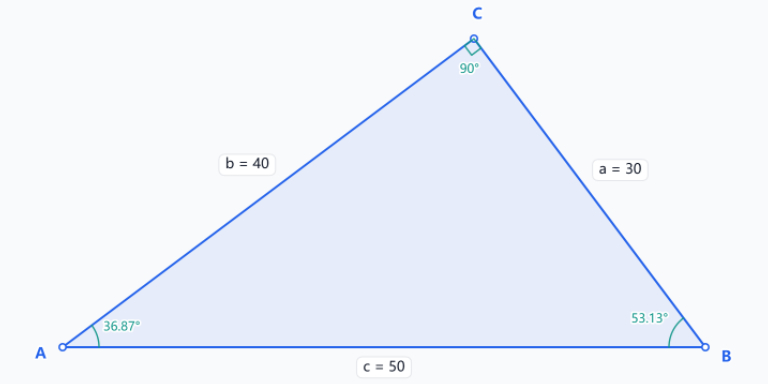
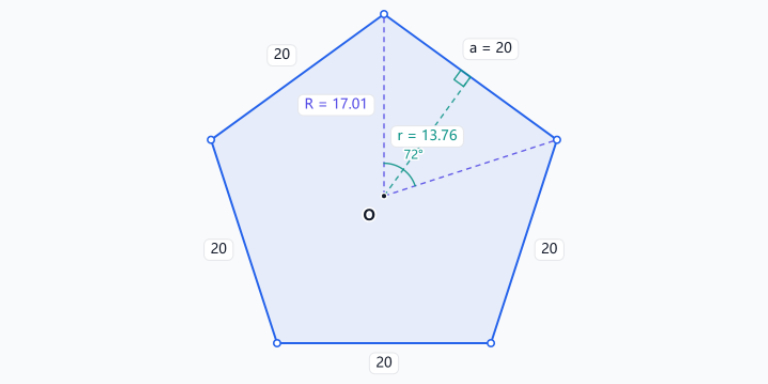
This calculator belongs to the Math cluster on BunTool, where every page follows the same structure: definition, formulas, worked examples, FAQ. If your shape has five sides, the pentagon calculator applies the same identities with n = 5; if you are working from three sides, or from two sides and the included angle, the triangle calculator covers those cases. The full set of geometry and algebra tools lives under Math.